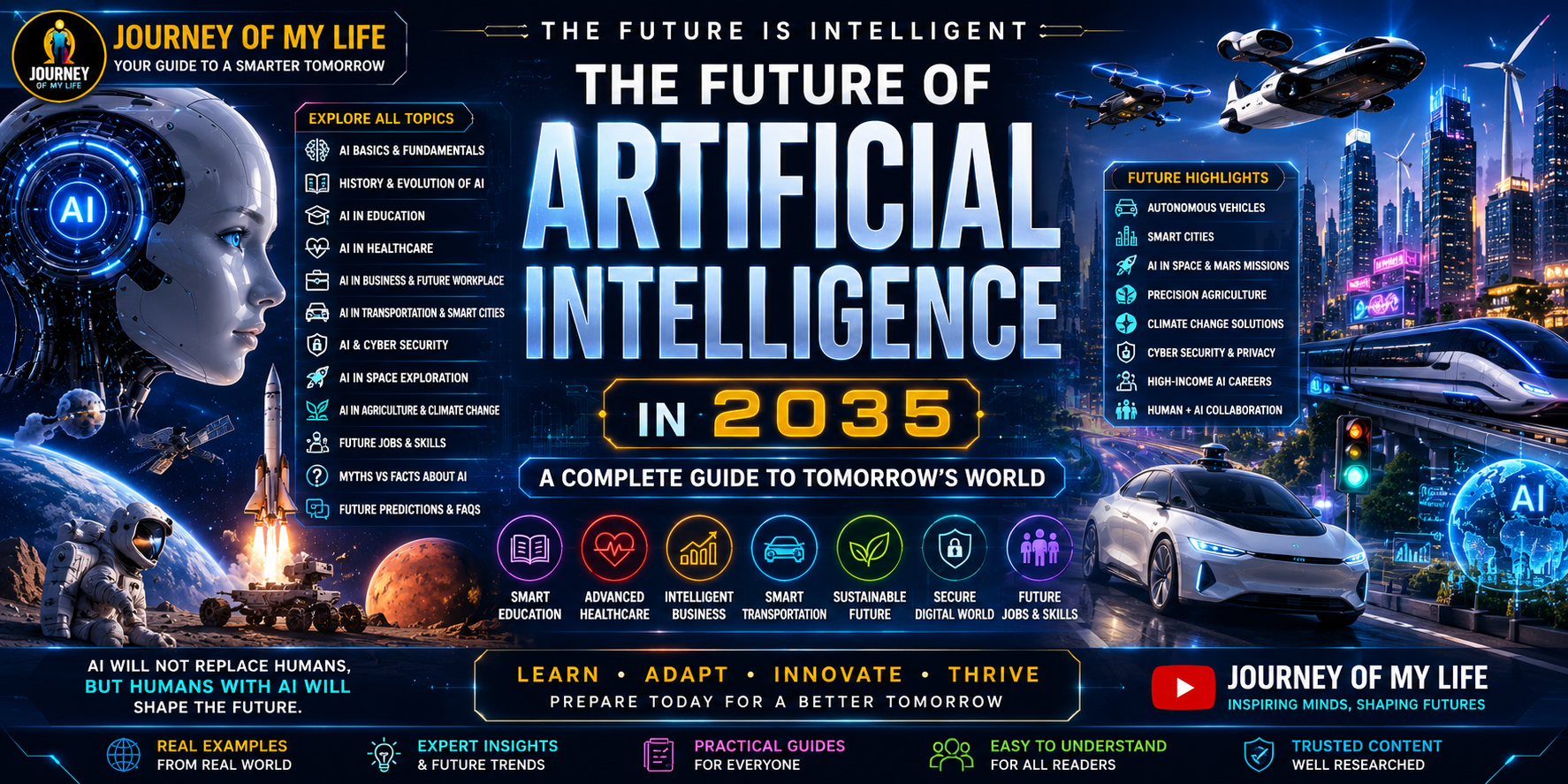
Introduction
Artificial Intelligence has already become one of the most revolutionary technologies in human history. From smartphones and self-driving cars to healthcare and scientific research, AI is changing how we work, communicate and solve problems.
By 2035, Artificial Intelligence is expected to become deeply integrated into everyday life. Intelligent assistants, autonomous machines, advanced robotics and personalized digital services will reshape industries and create opportunities that seem impossible today.
This article explores the future of Artificial Intelligence, emerging innovations, expected benefits, potential risks and how society can prepare for an AI-powered future.
📚 Table of Contents
Future of Artificial Intelligence
Artificial Intelligence is evolving beyond automation. Future AI systems will understand language more naturally, make complex decisions, collaborate with humans and continuously improve through learning.
AI in 2035
Experts predict AI will become an invisible technology working quietly in the background of nearly every digital product and service used by billions of people worldwide.
🤖 Smart Robots
Robots will assist humans in homes, factories, hospitals and public services with advanced intelligence.
🚗 Autonomous Transport
Self-driving vehicles will improve road safety, logistics and urban transportation.
🏥 AI Healthcare
Medical diagnosis, drug discovery and personalized treatments will become faster and more accurate.
AI Growth by 2035
Artificial Intelligence is expected to grow faster than any previous digital revolution. By 2035, AI will power almost every industry, from education and healthcare to agriculture, finance, transportation and scientific research.
Businesses will increasingly rely on AI to automate repetitive work, analyze massive amounts of data, predict future trends and deliver highly personalized services to customers.
📈 Business
AI-powered decision making, automation and intelligent customer support will improve productivity and reduce operational costs.
🎓 Education
Every student will have a personalized AI tutor capable of adapting lessons according to learning speed and skill level.
🌾 Agriculture
Smart farming systems will monitor soil health, predict crop diseases and maximize food production using AI analytics.
🏦 Finance
Fraud detection, investment strategies and financial planning will become more accurate with intelligent algorithms.
Industries That Will Change Completely
Nearly every major industry will experience significant transformation as Artificial Intelligence becomes more capable and affordable.
🏥 Healthcare
Early disease detection, robotic surgery, AI diagnostics and personalized medicine will improve patient outcomes.
🚘 Transportation
Autonomous vehicles, intelligent traffic systems and AI logistics will reduce accidents and travel time.
🏭 Manufacturing
Smart factories will use AI-powered robots to produce goods with greater speed, precision and efficiency.
🛰 Space Exploration
AI robots will assist astronauts, explore distant planets and analyze massive scientific datasets.
🛍 Retail
Shopping experiences will become fully personalized using AI recommendations and virtual assistants.
⚖ Government
AI will improve public services, digital governance and resource management while reducing paperwork.
Major Benefits of Artificial Intelligence
AI has the potential to improve quality of life while solving some of humanity's biggest challenges.
Top Benefits
Higher productivity, better healthcare, personalized education, safer transportation, scientific discoveries and faster innovation are among the biggest advantages expected over the next decade.
⚡ Faster Decisions
AI analyzes millions of data points within seconds to support accurate decision making.
💰 Cost Reduction
Automation minimizes repetitive work and reduces business expenses.
🌍 Global Connectivity
Real-time translation and intelligent communication tools will remove language barriers.
🔬 Scientific Innovation
AI will accelerate discoveries in medicine, energy, climate science and engineering.
AI Timeline: 2025–2035
2025
Generative AI becomes mainstream in business, education and software development.
2027
Autonomous delivery systems and AI assistants become common worldwide.
2030
Smart cities integrate AI into transportation, healthcare and public infrastructure.
2033
Robotics becomes widely adopted in homes, industries and medical facilities.
2035
AI becomes an essential part of everyday life, supporting billions of people around the globe.
Challenges & Risks of Artificial Intelligence
Although Artificial Intelligence offers tremendous opportunities, it also presents significant challenges. Governments, businesses and society must work together to ensure AI is developed responsibly, ethically and securely.
🔒 Privacy
Large-scale AI systems collect and process huge amounts of personal data. Strong privacy protection and transparent policies are essential.
💼 Job Displacement
Automation may replace repetitive jobs, making reskilling and lifelong learning increasingly important.
⚖ Ethical Concerns
AI decisions should remain fair, unbiased and explainable to avoid discrimination and misuse.
🛡 Cyber Security
As AI becomes more powerful, protecting systems from cyber attacks and malicious AI will become a global priority.
Future Jobs Created by AI
While some traditional jobs will change, AI is also expected to create millions of new career opportunities requiring technical, creative and human-centered skills.
🤖 AI Engineer
Designing intelligent systems, machine learning models and automation platforms.
📊 Data Scientist
Analyzing large datasets to generate valuable business and scientific insights.
🧠 AI Ethics Specialist
Ensuring AI systems are transparent, responsible and aligned with ethical standards.
🔐 AI Security Expert
Protecting AI platforms from attacks, vulnerabilities and misuse.
🎨 AI Content Creator
Creating articles, videos, designs and interactive experiences with AI-powered tools.
🚀 Robotics Engineer
Developing intelligent robots for healthcare, manufacturing, logistics and space exploration.
Frequently Asked Questions (FAQ)
Will AI replace humans?
AI will automate many repetitive tasks, but human creativity, emotional intelligence and critical thinking will remain essential.
Is AI safe?
AI can be safe when developed with proper regulations, security measures and ethical guidelines.
Which industries will benefit the most?
Healthcare, education, finance, agriculture, transportation, manufacturing and scientific research are expected to benefit significantly.
Should students learn AI?
Yes. AI literacy, programming, data analysis and problem-solving skills will become highly valuable for future careers.
Conclusion
Artificial Intelligence is no longer a concept of the distant future—it is already transforming the world around us. By 2035, AI will become deeply integrated into our daily lives, helping people solve complex problems, improve healthcare, enhance education and drive innovation across every major industry.
The greatest success will come from combining human creativity with the speed and intelligence of AI. Those who embrace continuous learning and adapt to technological change will be best prepared for the opportunities of the AI-powered future.
Final Thought
Artificial Intelligence is not just about smarter machines—it is about building a smarter, safer and more connected future for humanity. Responsible innovation will determine how successfully AI benefits generations to come.