🌍 Welcome to the Future
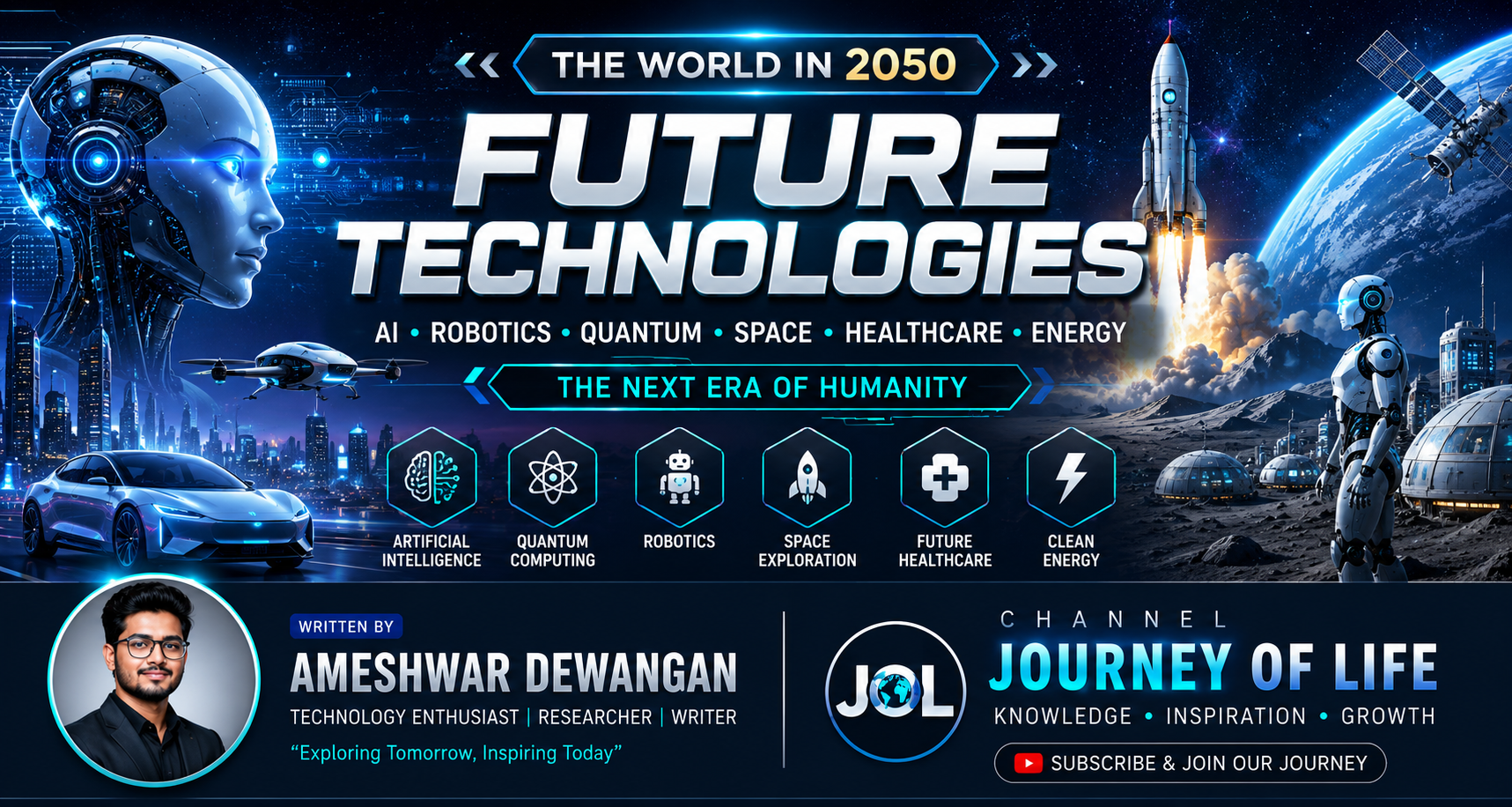
The world is changing faster than ever before. Artificial Intelligence, Quantum Computing, Biotechnology, Robotics, Space Exploration and Green Energy are creating a new era of innovation. By 2050, these technologies will reshape the way we live, work, communicate and explore the universe.
In this comprehensive guide, you'll discover the most exciting technologies expected to transform our future, understand how they work and explore their real-world impact on humanity.
📚 Table of Contents
🚀 What Are Future Technologies?
Future technologies are advanced innovations that have the potential to completely transform human civilization. These technologies are designed to solve today's biggest problems while creating opportunities that were once considered impossible. From intelligent robots to quantum computers and from flying taxis to Mars colonies, the coming decades will witness one of the greatest technological revolutions in history.
Unlike traditional inventions, future technologies are interconnected. Artificial Intelligence works together with Robotics, Quantum Computing enhances AI, Biotechnology improves healthcare and Space Technology expands human civilization beyond Earth. Together they form an intelligent ecosystem that will redefine how humans live, learn, travel and communicate.
Experts predict that by 2050, technology will become deeply integrated into everyday life. Smart homes, autonomous transportation, personalized medicine, intelligent education systems and advanced clean energy will become common across the world.
🤖 Artificial Intelligence Revolution
Artificial Intelligence is expected to become the foundation of every modern technology. AI systems will not only automate repetitive tasks but also assist doctors, scientists, engineers, teachers and governments in making faster and smarter decisions. Future AI will understand natural language, recognize emotions and collaborate with humans in real time.
🧠 Smart AI Assistants
Future assistants will schedule meetings, manage businesses, translate languages instantly and even provide emotional support.
🏥 Healthcare AI
AI-powered diagnosis, robotic surgeries and personalized treatments will improve life expectancy and reduce medical costs.
🎓 Education AI
Every student may have a personal AI tutor capable of teaching according to individual learning speed and interests.
🏭 Industrial AI
Factories will use intelligent robots to manufacture products with minimal waste and maximum efficiency.
💡 Why AI Will Lead the Future
Artificial Intelligence is the core technology that connects almost every other innovation. Whether it is healthcare, transportation, agriculture, education, finance or space exploration, AI will provide the intelligence required to make systems faster, safer and more efficient.
⚛ Quantum Computing
Quantum Computing represents one of the biggest leaps in computing history. Unlike classical computers that use binary bits, quantum computers use qubits, enabling them to process enormous amounts of information simultaneously.
By 2050, Quantum Computing could revolutionize scientific research, climate prediction, pharmaceutical development, cybersecurity and Artificial Intelligence by solving problems that today's fastest supercomputers cannot handle.
🔬 Drug Discovery
Scientists will simulate molecules within minutes instead of years, accelerating the discovery of life-saving medicines.
🌦 Climate Modeling
Quantum simulations will improve weather prediction and climate change research with unprecedented accuracy.
🔐 Cyber Security
Quantum encryption will provide stronger security while also creating new cybersecurity challenges.
🤖 Robotics: The Intelligent Machines of Tomorrow
By 2050, robots will become an essential part of everyday life. They will not only work in factories but also assist doctors in hospitals, help teachers in classrooms, perform dangerous rescue missions and even support astronauts during deep-space exploration.
Future robots will combine Artificial Intelligence, Computer Vision, Voice Recognition and Human-like Motion to understand commands, solve problems and interact naturally with people.
🏠 Home Robots
Cleaning, cooking, security monitoring, elderly care and child assistance will become everyday responsibilities of intelligent home robots.
🏥 Medical Robots
Highly precise robotic surgeons will perform complex operations with minimal human intervention, increasing safety and recovery rates.
🚒 Rescue Robots
Robots will enter dangerous environments such as earthquakes, floods and nuclear accidents to save lives.
🚀 Space Robots
Autonomous robots will build Moon and Mars bases before humans permanently settle there.
🚀 Space Exploration & Human Colonies
Humanity is preparing for a future beyond Earth. By 2050, permanent research stations on the Moon and the first sustainable settlements on Mars may become reality. Advanced rockets, reusable spacecraft, AI navigation and robotic construction will dramatically reduce the cost of space travel.
🌌 Future Space Missions
Future missions will search for life beyond Earth, mine valuable resources from asteroids, build orbital space stations and prepare humans for interplanetary civilization.
🌕 Moon Cities
Permanent lunar habitats may become research centers for science, mining and future deep-space missions.
🔴 Mars Colonies
Advanced life-support systems, AI agriculture and 3D-printed homes could make Mars habitable.
☄ Asteroid Mining
Rare metals and valuable minerals from asteroids could fuel Earth's future economy.
🛰 AI Satellites
Intelligent satellite networks will provide global internet, climate monitoring and disaster prediction.
🩺 Future Healthcare Technologies
Healthcare will become faster, smarter and more personalized through Artificial Intelligence, Gene Editing, Nanotechnology and Wearable Health Devices. Diseases may be detected years before symptoms appear.
🧬 Gene Editing
Advanced genetic engineering may eliminate inherited diseases and improve human health.
💊 Personalized Medicine
Every treatment will be designed specifically for an individual's DNA and lifestyle.
⌚ Smart Wearables
Wearable devices will continuously monitor health and instantly alert doctors during emergencies.
🔬 Nanomedicine
Tiny medical robots may travel through the bloodstream to repair damaged cells and destroy cancer.
💡 Technology Insight
The future will not be shaped by a single technology. Artificial Intelligence, Robotics, Quantum Computing, Biotechnology and Space Science will work together to create a smarter, healthier and more connected civilization.
⚡ Future Energy Revolution
Energy is the foundation of every civilization. By 2050, the world will move beyond fossil fuels toward cleaner, smarter and more sustainable energy sources. Artificial Intelligence, Nuclear Fusion, Solar Technology and Smart Energy Grids will work together to power billions of people while protecting the environment.
Scientists are developing technologies capable of producing almost unlimited clean electricity. These innovations could reduce pollution, lower electricity costs and help combat climate change.
☀ Next Generation Solar
Future solar panels will generate far more electricity while occupying less space and working efficiently even during cloudy weather.
⚛ Nuclear Fusion
Fusion energy promises nearly unlimited clean electricity without the long-term radioactive waste associated with traditional nuclear power.
🌊 Ocean Energy
Ocean waves and tides could become major renewable energy sources for coastal nations.
🔋 Super Batteries
Future batteries may charge within minutes and power electric vehicles for thousands of kilometers.
🏙 Smart Cities of 2050
The cities of tomorrow will be connected through Artificial Intelligence, IoT sensors, autonomous transportation and intelligent public services. Roads, hospitals, schools and emergency systems will communicate with each other in real time.
🚦 Smart Traffic
AI-powered traffic systems will reduce congestion, accidents and travel time across major cities.
🏢 Intelligent Buildings
Buildings will automatically optimize electricity, temperature, security and water usage.
🛰 City Monitoring
Thousands of connected sensors will monitor pollution, weather, transportation and public safety.
🌳 Green Infrastructure
Urban forests, vertical gardens and smart parks will improve air quality and create healthier environments.
🚗 Future Transportation
Transportation will become faster, safer and cleaner. Self-driving cars, flying taxis, hyperloop systems and high-speed electric trains could transform global travel over the coming decades.
🚘 Autonomous Cars
AI-driven vehicles will communicate with roads and each other, dramatically reducing road accidents.
🚁 Flying Taxis
Electric vertical takeoff aircraft may provide fast transportation inside large cities.
🚄 Hyperloop
Vacuum-tube transportation systems could move passengers at speeds exceeding 1,000 km/h.
🛸 Space Tourism
Commercial space travel may become affordable for millions of people before the end of the century.
🌍 The Future Begins Today
The technologies shaping 2050 are already being developed today. Every breakthrough in Artificial Intelligence, Robotics, Energy, Medicine and Space Exploration brings humanity one step closer to a smarter, safer and more sustainable future.
💼 Future Jobs That Will Dominate by 2050
Technology will not only automate work but also create entirely new careers. Many of the highest-paying jobs of 2050 do not even exist today. Professionals who continuously learn new digital skills will be best prepared for the future economy.
🤖 AI Engineer
Design intelligent machines, smart assistants and advanced AI platforms that solve real-world problems.
⚛ Quantum Programmer
Develop software for quantum computers capable of solving impossible computational challenges.
🧬 Genetic Engineer
Create medical treatments using DNA technology to eliminate inherited diseases.
🚀 Space Architect
Design sustainable homes, research laboratories and smart cities for the Moon and Mars.
🛡 Cyber Security Specialist
Protect governments, businesses and AI systems against future cyber threats.
🌍 Climate Technology Expert
Develop smart environmental solutions that reduce pollution and protect natural resources.
🌐 Internet of the Future
The internet of 2050 will be far more intelligent than today's web. AI-powered search engines, holographic meetings, immersive virtual environments and instant multilingual communication will redefine digital experiences.
🥽 Mixed Reality Internet
Virtual Reality and Augmented Reality will merge into everyday online experiences.
🛰 Global Satellite Internet
High-speed internet access will reach even the most remote places on Earth.
🎙 Instant Language Translation
AI will remove language barriers through real-time voice translation.
📡 7G & Beyond
Future communication networks will provide near-instant global connectivity.
📅 Technology Timeline (2025–2050)
2025
Generative AI becomes mainstream in education, business and software development.
2030
Autonomous transportation, AI healthcare and smart cities expand across the world.
2035
Commercial flying taxis, advanced robotics and intelligent homes become common.
2040
Quantum computers transform medicine, climate science and cybersecurity.
2045
Moon research stations and commercial space industries rapidly expand.
2050
AI, Robotics, Biotechnology and Clean Energy become the foundation of modern civilization.
🚀 Vision 2050
The future is not something that simply happens—it is something humanity creates. Every innovation, every scientific breakthrough and every new idea brings us closer to a world that is smarter, healthier, greener and more connected than ever before.
🌟 Top 100 Future Technologies (Part 1)
The following technologies are expected to become the foundation of human civilization by 2050. Some already exist in early stages, while others are still under research and development.
01. Artificial General Intelligence (AGI)
Human-level AI capable of learning, reasoning and solving complex problems independently.
02. Quantum Artificial Intelligence
Combining AI with quantum computing for unimaginable processing power.
03. Brain Computer Interface
Direct communication between the human brain and computers using neural signals.
04. Fully Autonomous Robots
Robots capable of working without human supervision across industries.
05. Flying Electric Cars
Urban air mobility will reduce traffic and revolutionize transportation.
06. Hyperloop Transport
Ultra-high-speed travel through low-pressure vacuum tubes.
07. Smart Contact Lenses
Augmented Reality displays directly inside wearable contact lenses.
08. Digital Human Avatars
AI-powered virtual humans for education, healthcare and business.
09. Nanotechnology Medicine
Microscopic robots repairing cells from inside the human body.
10. AI Scientists
Artificial Intelligence discovering new medicines, materials and scientific theories.
⚠ Challenges for Future Technologies
Every technological revolution creates both opportunities and responsibilities. While innovation can improve billions of lives, it also requires careful planning, ethical governance and global cooperation.
🔒 Privacy Protection
Future technologies must safeguard personal information while respecting individual rights.
⚖ AI Ethics
Artificial Intelligence should remain transparent, fair and accountable for its decisions.
🌍 Climate Responsibility
Technology should reduce environmental impact rather than increase pollution.
🛡 Cyber Defense
Advanced security systems will be essential for protecting digital infrastructure.
💬 Frequently Asked Questions
Will technology replace humans?
Technology will automate repetitive work, but creativity, leadership, empathy and critical thinking will continue to make humans indispensable.
Which technology will have the biggest impact?
Artificial Intelligence is expected to influence nearly every field, including medicine, education, transportation, business and scientific research.
Will humans live on Mars by 2050?
Many experts believe permanent research bases on Mars may become possible by the middle of this century, although large-scale settlements remain uncertain.
How should students prepare for the future?
Learning AI, programming, communication, creativity, critical thinking and continuous problem-solving will help students adapt to future careers.
🔮 Future Predictions: Life in 2050
By the year 2050, daily life may be almost unrecognizable compared to today. Artificial Intelligence will quietly assist people throughout the day, transportation will become autonomous, healthcare will become predictive rather than reactive, and homes will automatically adapt to their residents' needs.
Although the exact future cannot be predicted, many scientists believe that the next 25 years will bring more technological progress than the previous century.
🏠 Smart Homes
AI-powered homes will automatically control lighting, temperature, security, entertainment and energy consumption.
👨⚕ Personal AI Doctor
Wearable devices and AI assistants may monitor health 24/7 and detect diseases before symptoms appear.
🎓 AI Education
Every learner could receive a personalized education plan designed around their strengths and goals.
🌍 Carbon-Neutral Cities
Clean energy, electric transportation and intelligent infrastructure could dramatically reduce pollution.
🚀 Commercial Space Travel
Space tourism and orbital hotels may become available to a much larger number of people.
🤖 Human-AI Collaboration
People and AI systems will increasingly work together in research, business, medicine and engineering.
🏁 Conclusion
The technologies discussed throughout this article represent some of the most exciting possibilities for the future. Artificial Intelligence, Robotics, Quantum Computing, Biotechnology, Clean Energy and Space Exploration are expected to shape the next era of human civilization.
While innovation offers tremendous opportunities, it also requires responsible leadership, ethical development and global cooperation. The choices made today will influence how technology benefits future generations.
🌍 Final Thought
"The future is built by people who imagine possibilities, embrace innovation and never stop learning."